Spend a few minutes trying to remember a concept before opening the notes. Write what you can explain, then check the answer against the official guide or the worked example. Keep several short sessions on the calendar so you can see what remains available after a gap.
The US Institute of Education Sciences describes spacing learning over time and using quizzes to promote later recall. The guide addresses settings covered by the studies it reviewed. Use the method for a skill you can test directly, such as explaining the role of a cloud access policy from a fresh example. Institute of Education Sciences
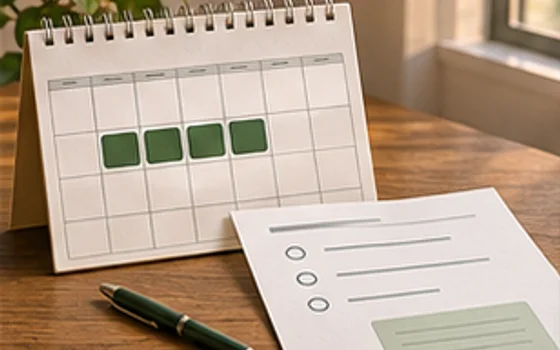
Put the questions on a small calendar
| Day | Work |
|---|---|
| 1 | Read the objectives and write four questions in your own words. |
| 3 | Attempt all four from memory. Mark partial answers and check each against the source. |
| 6 | Write a fresh example for the two you missed. Recheck one of the correct answers. |
| 10 | Explain the hardest item aloud and complete a small related task. |
| 14 | Try all four with new details and decide what to review again. |
These dates are a sample sequence. If a correct answer only comes back after a long hint, try it closer to the next session. If a term comes easily and you can apply it to a new case, spread out the next check. Give yourself the answer after each attempt so an error does not become the thing you keep rehearsing.
Microsoft’s certification overview points to exam and preparation resources that can help you choose which topics to test. Write each recall item under a named objective. When a provider changes the outline, you can see whether an old question still fits. Microsoft Learn
Write questions whose answers can change with the situation
Begin with an actual study objective or task. Suppose you are learning which person controls access to a shared cloud file. A simple recall card can ask “Who manages access to the file in this example?” Include enough context to choose a meaningful answer. Make a second card that changes who owns the file or what kind of access is needed. You can then check whether you remember a useful distinction or just the words from the first prompt.
Make some questions short enough to answer without a screen. On a calendar break you could sketch one simple data relationship or list which conditions make a rule apply. Keep the official answer nearby so you can check the wording after you respond. If a provider publishes multiple study resources, use the one that applies to the exam you are taking. Microsoft’s certification process overview points to exam and preparation pages, which can help you identify the current objective before writing a new question. Microsoft Learn
Use a quick scale for your own study notes. An answer might be complete, partial, or still missing. Give an example of what you require for each. A correct label with an unclear explanation could be partial. An answer that gives the role and what it would check in a fresh situation might be complete. Write down why you marked it that way. When you return, open the question first so the last answer does not become a hint. Make the next check smaller if you still cannot give a basic explanation after reviewing the official example.
Adjust the interval after you see what you remember
The US Institute of Education Sciences’ practice guide discusses spreading study across time and using quizzes to support recall. Its guidance draws from educational studies. The two-week schedule here is a way to try the principle for a specific goal. A difficult item may benefit from an earlier return. An answer you can give and apply after multiple gaps can appear less often in your practice. Keep the spacing decision simple enough to maintain. Record a reason if you change the schedule, such as one question requiring a hint the second time. Institute of Education Sciences
Suppose you can name the topic on day three and cannot tell which condition determines the answer. Review one worked case and write another with a small change. Try it a few days later. If you remember the rule but make the same mistake in the changed case, give yourself a smaller question that focuses on that condition. If you can explain and use it by day ten, mark it for a later check and use the next short session for something you still cannot retrieve. Change the next review date for that question and leave the other sessions on the calendar.
Resume after missing several days
If you miss a planned session, give yourself one short closed-notes check when you return. Start with a question that needs to be available soon. Try to answer before rereading the chapter, then compare your response with the source. You might remember the definition and skip its application. Keep the part you can retrieve and make a new variation for the step you forgot. If the exercise still blocks you, write one hint and see how much you can answer with it next time.
Use the end of the two weeks to decide what you will carry into another project or exam session. Create a fresh example rather than asking yourself whether the old answer looks familiar. Check both your explanation and the observable result. If you practiced an exception rule, show one case where the usual rule applies and another where it changes. Save the version of the guide and the date of the next check. When a lesson is no longer relevant to your work, you can remove it from the calendar and keep the concepts you still need.
Record why an answer was partial
A useful record has the date, question, result, and next date. Include why an answer was partial. “Remembered what storage means, guessed who controls access” suggests a smaller new question. You can then sketch the service and explain which person manages which setting.
Keep the routine short enough to continue during a busy week. A five-minute check can cover one weak concept and one item you last saw several days ago. At the end of two weeks, decide which topic can wait and which needs another example or a different explanation.
A later practice test can help separate recurring gaps from details that return after a few retrieval sessions.